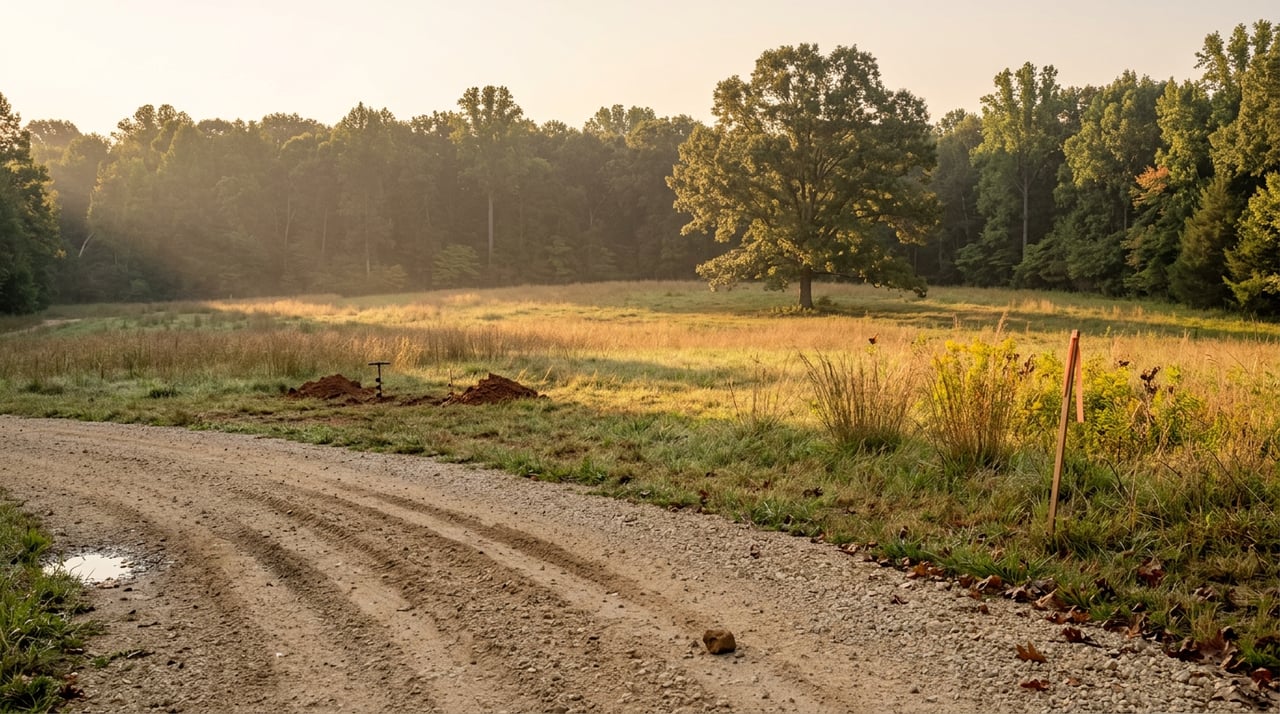
Open two Powhatan land listings priced within a few thousand dollars of each other. One is a 10-acre parcel in Maidens with public water at the road and soil tests already approved for a four-bedroom drain field. The other is a wooded 10 acres off a gravel easement with nothing on it but trees and a tax map number. On paper, they cost about the same. In practice, one is a house site and the other is a research project that may or may not end in a house.
That gap between listing price and buildable cost is the story of buying land in Powhatan. The median list price per acre in Powhatan County sits around $25,000 for parcels of 10 acres or more, with broader aggregators showing county averages closer to $51,680 per acre once smaller lots are mixed in. Neither number tells you what a lot will actually cost to build on. Soil does. A well driller does. Powhatan County's permit desk does.
The Median Is a Number That Hides Everything
Price per acre is a fine sorting tool and a poor predictor. Two forces pull it in opposite directions in Powhatan. On one end, hunting tracts and timber acreage push the median down. On the other end, gated communities like Greywalls, which surrounds The Foundry Golf Course and is releasing its final section of 2.00 to 6.09-acre homesites, push the ceiling up. Rural building costs in Powhatan County sit at roughly $175 to $250 per square foot for complete rural installations, but that number assumes suitable soil and a reasonable well depth. Change either variable and the pro forma changes with it.
The useful question is not "what does an acre cost." It is "what does this acre cost after the soil scientist and the well driller have their say."
The AOSE Report Is the Real Sale Price
Before a shovel moves in Powhatan, an Authorized Onsite Soil Evaluator has to walk the property. In Virginia the AOSE is a DPOR-licensed professional trained to evaluate soil conditions, percolation rates, water table depth, and site suitability for onsite sewage systems, and the evaluation is not optional. VDH requires a certified evaluation before accepting any permit application for new construction, system replacement on a different footprint, or voluntary upgrades.
That report determines which of two very different budgets a buyer is on. Virginia does not use a strict pass-fail perc rate. It uses a soil profile system, where soils rated Class I–III generally support conventional gravity systems; Class IV soils require pressure-dosed or alternative on-site systems. A failure usually means a recirculating sand filter or peat-based system, which can add $20,000–$40,000 to a build.
The gap between the two outcomes is the entire margin on a modest new-construction budget. A conventional gravity system on a well-drained lot runs $4,000 to $8,000 installed. An engineered alternative on a heavy clay slope can run $15,000 to $55,000. And the permitting itself is not a rounding error. AOSE fees run $500 to $1,200 depending on site complexity and location, and total VDH permitting typically pushes the pre-construction paperwork to $925 to $1,700 before any construction begins.
The practical implication for a Powhatan buyer: an offer on raw land should be contingent on a passing AOSE evaluation, and the buyer should read the soil class before the loan closes. The soil determines the septic. The septic determines the drain field footprint. The drain field footprint determines where the house can go. Everything downstream of that report is negotiable. The report itself is not.
Well Depth Is Where the Piedmont Gets Expensive
Powhatan sits in the Virginia Piedmont, and Piedmont geology sets the ceiling on how cheap a private well can be. Statewide, the average residential well depth in Virginia is 210 feet, but wells in the state range from 50 to 600 feet depending on your location and local geology, and the Piedmont sits at the deeper end. Water table depths in the region run 80 to 300 feet, and drilling cost tracks depth almost linearly at $28 to $62 per foot, with a complete Virginia well system typically landing between $5,000 and $15,000, depending on depth, geology, and equipment choices.
There is one more Piedmont-specific risk buyers rarely factor in. Some crystalline-rock lots simply do not produce enough water. Wells drilled in the Blue Ridge crystalline rocks in western Fauquier county, or in a basalt flow in the Triassic Basin, may generate less than the 3-5 gallons/minute usually required to obtain a mortgage on a new house. The same crystalline geology runs through parts of the Powhatan Piedmont. A well that comes in at 1.5 gpm is not a well that a conventional lender will underwrite against, and the fix is either a storage tank system or a second bore hole. Both cost money the listing did not mention.
What Powhatan County Itself Requires
Layer the county rules on top of the state rules and a few Powhatan-specific frictions appear:
- Minimum lot size for private septic. In Virginia, the minimum lot size for any lot not served by public sewer is one acre. Most Powhatan buildable parcels clear that easily, but it matters on odd-shaped legacy parcels and family land splits.
- Building code. Powhatan is currently under the 2021 Virginia Uniform Statewide Building Code, which drives the plan review your builder will submit.
- Land Disturbance Permit. The county requires an LDP prior to a Land Disturbing Activity impacting 10,000 square feet or more of land. For a single dwelling, property owners may submit an "Agreement in Lieu of a Plan" this form grants an exemption from needing a Land Disturbance Permit (LDP) so long as the property owner agrees in writing to meet the standards set forth by the Virginia Erosion and Sediment Control Law and that the area of land disturbance is less than 1 acre. Cross the acre threshold and DEQ enters the picture: Land Disturbing Activities that exceed an Acre or more in size will require additional permitting from the Department of Environmental Quality (DEQ). Additionally, if streams, lakes or wetlands are present, DEQ will require mitigation credits be purchased prior to land disturbance.
- Timing. Soil evaluation and VDH review typically add 4 to 8 weeks to a rural Virginia project, and a well runs another 4 to 8 weeks from your first call to potable water. These calendars run in parallel, but the closing timeline still needs to accommodate them.
None of these are dealbreakers. They are line items. Buyers who miss them find them later, at cost.
How to Read a Powhatan Land Listing
The listings themselves tell you which diligence risks you are buying, if you know what to read for. A few current examples from active inventory:
| Listing | What the listing already resolves | What the buyer still owns |
|---|---|---|
| Beaumont on the James, 10-acre riverfront lots off Route 522 in Maidens | Public water hook-up is available with each lot- rare in Powhatan! All lots have perked for a 4 bedroom home- drain field and home placement are marked | Well not needed, but flood elevation and river setbacks |
| Greywalls Section 4, gated community around The Foundry Golf Course | 2.00 to 6.09 acres in a platted, deed-restricted development | HOA architectural review, custom-build cost per sq ft |
| 1981 Urbine Road, 10.3 acres in eastern Powhatan | well, conventional septic, and electric already onsite plus approved soil tests | Confirm well yield, verify septic capacity for planned bedroom count |
| Ballsville Road buildable lot, 22+ acres | Dominion Power is available at the street | Well and septic will be needed, driveway/access, full AOSE work |
| Land-locked parcel referenced as Tax Map # 14-35 | Priced accordingly | Property does not have legal access and being sold as is — access easement negotiation before anything else |
The pattern is straightforward. Lots where the previous owner already spent money on perc tests, well work, or utility runs are priced with that spend baked in. Raw lots that look cheaper on paper are cheaper because the buyer is about to spend that money themselves. Rock River Homes puts the rough magnitude at budgeting an additional 20% – 100% or more over sale price for site prep in rural Virginia. That range is wide because the range of Powhatan sites is wide.
A Short FAQ
Can I make an offer contingent on soil? Yes, and on Powhatan raw land it is standard practice. Experienced land buyers make their purchase contingent on a passing perc test before committing money to a property. The contingency should specify soil class outcomes, not just a binary pass or fail, because a Class IV result technically "passes" but changes the budget significantly.
How long is an old perc test good for? Treat any evaluation more than a few years old as informational, not decisive. Regulations have shifted, and site conditions like tree cover, grading, and drainage change. A new AOSE walk before closing is inexpensive relative to what it protects against.
What about lots already served by public utilities? They exist in Powhatan but are the exception, which is why listings like Beaumont on the James call the public water hookup out explicitly. Most of the county remains on private well and private septic, which is why the AOSE report matters as much as it does.
When You Are Ready to Look Past the Sticker
Land in Powhatan rewards buyers who read the diligence line items before the price per acre. That is the work we do every week with clients weighing parcels against each other, and it is the reason our sellers price legacy family land differently than developers price newly platted sections. If you are comparing two lots and cannot tell which one is actually the better deal, that is the conversation to have before you write the offer. Reach out to Hank Cosby Real Estate and we will walk the parcels with you, read the soil work, and tell you what the listing is not saying.